Ddijigi guide
Ddijigi is an app that colors in a folk painting of your zodiac guardian, one check-in a day. Here is how to use it, what it holds, where the paintings come from, and the question people born early in the year often ask about which zodiac sign they fall under. New here? Read from the top. Looking for one thing? Jump in from the table of contents.
What Ddijigi is
You hang a black-and-white painting of your zodiac guardian, and each day you tap one mood, and the color rises one shade. Fill all fourteen shades and the canvas is complete; that painting joins your collection as a card. One round runs about two weeks, and when it ends a fresh canvas opens.
Setup is picking one zodiac sign, and that is all. No account, no sign-up, no notifications. It takes about ten seconds a day, and those ten seconds become one shade of color. That is the whole idea.
One thing we want to say plainly: Ddijigi does not tell you what a zodiac sign says about your personality or who you are compatible with. We do not have grounds to back up claims like that. What this app covers is the painting and your own record.
Days you do not come do not cost you anything. Come back after a few days and the color is exactly where you left it. The first thing you hear on your return is a welcome, not a nudge. That is not an oversight; it is a line this app chose to hold.
How to use it
Pick your zodiac sign
The first screen asks you to pick one of the twelve zodiac signs. If you want to look up your sign by birth year, the zodiac calculator lists years from 1924 to 2040 by sign. People born in January or February can fall on either side of the boundary depending on which rule is used; that is covered in the background section below.
Tap one mood a day
There are five moods: a bright day, a gentle day, a hazy day, a soaked day, a stormy day. Whichever you tap, the color rises by the same one shade. We do not score good moods higher and bad moods lower. Showing up on a gray day is not worth less than showing up on a clear one.
A line of text is optional
Next to the mood buttons there is a field for one line of text. Leave it blank and the check-in still completes. For the moments a blank line feels hard to start, a question of the day sits there as a starting point, not a question meant to steer your answer. Twelve questions rotate, chosen by date and zodiac sign, so reopening the same day keeps the same question and a different sign sees a different one on the same day.
When the canvas fills up
Once all fourteen shades are filled, a completion notice appears and that round is kept as a card. Collected cards can be viewed anytime from the button near the top of the screen. Starting a new canvas resets the coloring to zero while earlier cards stay in your collection.
Where your records live
Moods and notes are stored only in this device's browser. There is no account and no personal identifier, and nothing is uploaded to a server. What we count is visits and check-ins, and even that is anonymous. Before switching devices or clearing your browser, export your records to a file, and importing it on a new device brings your guardian back exactly as it was.
What is inside
Twelve guardians, one folding screen
The paintings on screen come from a twelve-deities folding screen held by the National Museum of Korea. It is released under Korea Open Government License Type 1, which requires source attribution, and that same credit line runs everywhere a painting appears. Each of the twelve signs has its own panel, so whichever sign you pick, there is a painting waiting for you.
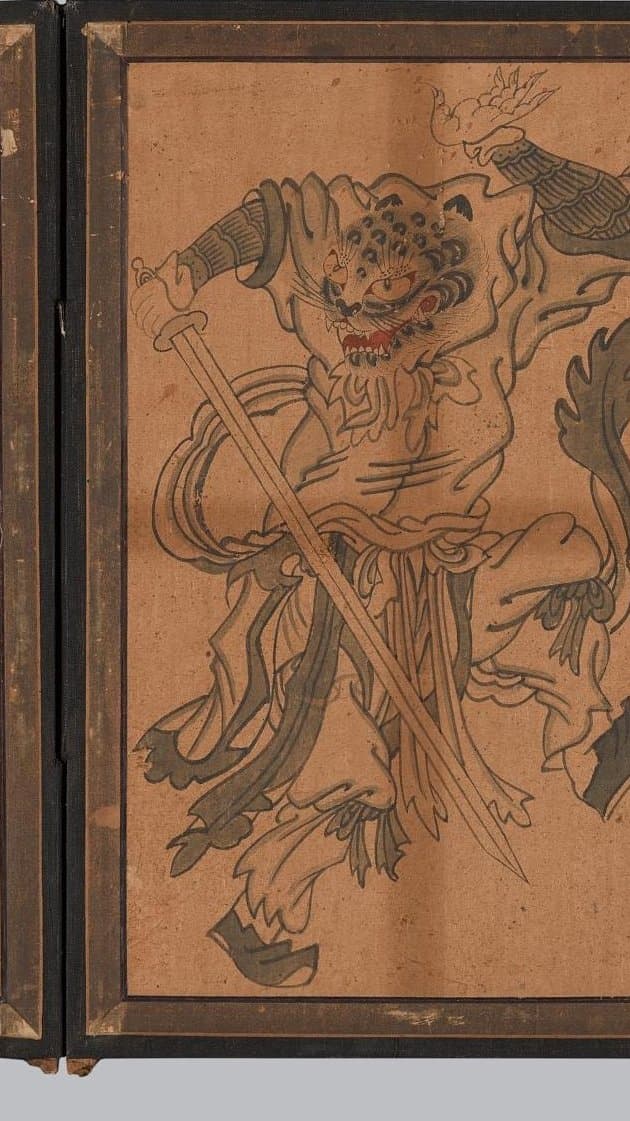
Color tones
The same painting is kept differently depending on which tone colors it. Original tone and ink wash are available to use now; Dancheong and blossom pink are still in the works, so you can only preview them briefly for now. Whichever tone you pick is recorded with that round's card, so the same guardian is remembered differently round to round.
Zodiac calculator and year pages
The zodiac calculator shows which years belong to each of the twelve signs, and the year pages show, one year at a time, which sign someone born that year holds. These are not a hand-typed list; both come from the same calculation, so they never drift apart from each other.
Guardian matchup
Guardian matchup puts two of the twelve panels side by side and asks which one you are drawn to. It is not about picking the stronger one, and nothing gets ranked. No account, no points, one vote each. It is also a place where all twelve panels get their turn facing each other.
What we chose not to sell
What we do not sell matters as much as what we do. The right to judge or interpret, restoring your progress and records, random draws in the style of a gacha, the right to create urgency and then charge to stop it, and anything not built yet. Those five stay off the table. What can carry a price is decoration only.
Looking closer
Watch how the color fills in
Coloring does not fill in section by section like a brush going over new patches; gray lifts and saturation rises across the whole painting at once. That is why any point between day one and the last day already reads as a finished picture in its own right. The first screen shows the starting state and the fully colored state side by side, so you can compare them before you even begin.
Line the twelve up together
All twelve panels come from a single folding screen, so what is shared and what differs shows more clearly when you move between several panels than when you look at just one. Page through the per-sign pages one by one, or see two placed side by side in the matchup screen.
Keep the painting close
The current state of your painting can be saved as a card or in phone-wallpaper proportions. The downloaded file carries the source credit with it. If the credit only lived on screen and not in the file, the moment that file travels it becomes an uncredited reprint.
If you need a precise zodiac reading
Ddijigi assigns your sign as an approximation based on birth year. If you need a reading that also weighs the time of birth, check Gwiraedang's calendar tool (Korean). The reason we point elsewhere instead of guessing is explained in the section below.
Background
The three notes below come from Korean academic papers, and what we checked was the title and abstract level, not the full text. We want to say that plainly before going on.
What the twelve zodiac signs stood for
A paper on the magical expression of animal imagery in Korean art, centered on twelve-zodiac iconography, frames the twelve signs as tied to the logic of yin-yang and the five elements, describing them as deities of time and direction, an icon linking people and the cosmos. In other words, a zodiac sign was not just a nickname for a birth year; it once carried duties around timekeeping and direction as well.
How long they have been in use
According to a paper examining the heavenly stems and earthly branches as a code for reading folk belief, the Korean peninsula had been using this ten-and-twelve sign system from at least the early fifth century, and it was tied to dates, directions, and colors, used broadly for matchmaking, choosing auspicious dates, and reading fortune.
Iconography falls into three types
A paper on the origin and development of the twelve-zodiac-deity imagery on Joseon royal tombs divides the iconography into three types: a human body with an animal head, a human body wearing a crown bearing the zodiac animal, and a mixed script form that blends the twelve signs, the ten stems, and the eight trigrams as characters. We have not yet checked, panel by panel, which type our twelve paintings belong to. We will not claim one until we have.
Two rules decide where a sign turns over
People born early in the year often run into a confusing situation: one source calls them the earlier sign, another calls them the next one. Neither is wrong. There are two different rules for when a zodiac sign turns over.
One is Lunar New Year. This treats the new year as beginning on Lunar New Year's Day, matching the everyday sense of turning a year older after bowing to elders and eating tteokguk. Under this rule, being born before Lunar New Year means the earlier sign. Since the date of Lunar New Year moves every year, the boundary moves with it.
The other is Ipchun, the start of spring. In Korean fortune-telling (myeongni), the year turns over at Ipchun, because the shift of season on the solar calendar is treated as the start of the year. Ipchun usually falls around February 4th, and even the time of day matters. This is the rule used for saju readings.
So which one applies depends on what you are using it for. Where a fortune-telling calculation is actually needed, Ipchun is the standard. When people talk about zodiac signs casually, or trade zodiac trivia, they usually go by Lunar New Year instead. In Ddijigi, pick whichever feels right to you.
Frequently asked
Did the color drop because I missed a few days?
No, it did not. We do not count missed days or push you to make up for them. Your guardian does not wither; it waits right where you left it. Just keep coloring from there.
Do I need to sign up?
No. There is no account, so there is no login and no password either. Since records live only on this device, use export and import when you switch devices.
Why no personality or compatibility readings by sign?
Because we have no grounds for it. Writing something that sounds plausible when we cannot back it up is the one thing this app should never do. Instead we included the paintings, their sources, and the background we could verify.
Can I use the painting freely?
The painting belongs to the National Museum of Korea and is released under Korea Open Government License Type 1, which allows use with attribution. We include that credit on screen and in every downloaded file. Saved cards carry the credit too, so you can share them as they are.
Is this available in English or Japanese?
The app itself works in Korean, English, and Japanese. Switch language near the top of the first screen, and the choice is carried in the address, so a shared link keeps it. This guide article now has this English translation as well; it may fall a little behind whenever the Korean original changes.
Does it cost anything?
Payments are not open yet. Two color tones are in the works and priced already, but they cannot be bought yet. Even once payments open, only decoration will carry a price; anything about your progress and records stays free.